
Contents
Hidden Tree Rot Can Turn a Healthy-Looking Tree Into a Serious Hazard
Across Monmouth County, we inspect many mature hardwood trees that look solid from the street but tell a different story at the trunk, root flare, or major limbs. Hidden tree rot is one of the most dangerous problems because it works inside the tree first. By the time a homeowner sees a cavity, mushroom, crack, or broken limb, the decay may already be affecting the structure that holds the tree upright.
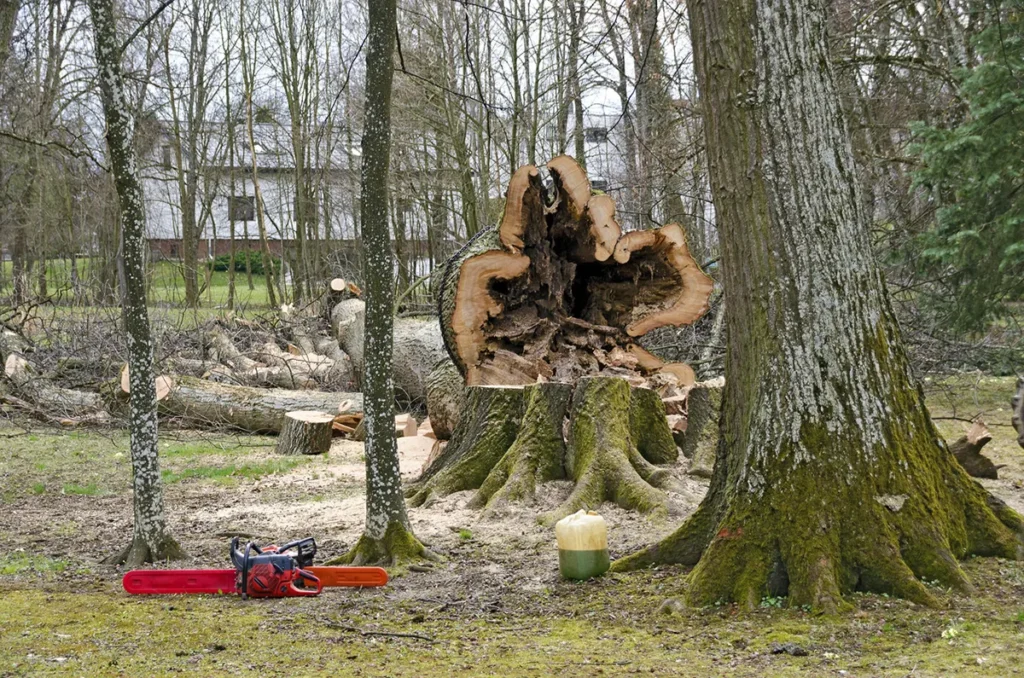
Hufnagel Tree Service is based in the Middletown area and provides certified arborist tree care across Monmouth County. We work on old oaks, maples, beeches, ashes, sycamores, tulip trees, cherries, and other hardwoods growing near homes, driveways, sidewalks, fences, pools, garages, and utility lines. Our job is not to scare people into removing trees. Our job is to evaluate risk honestly and determine whether a tree can be restored or whether it has become unsafe.
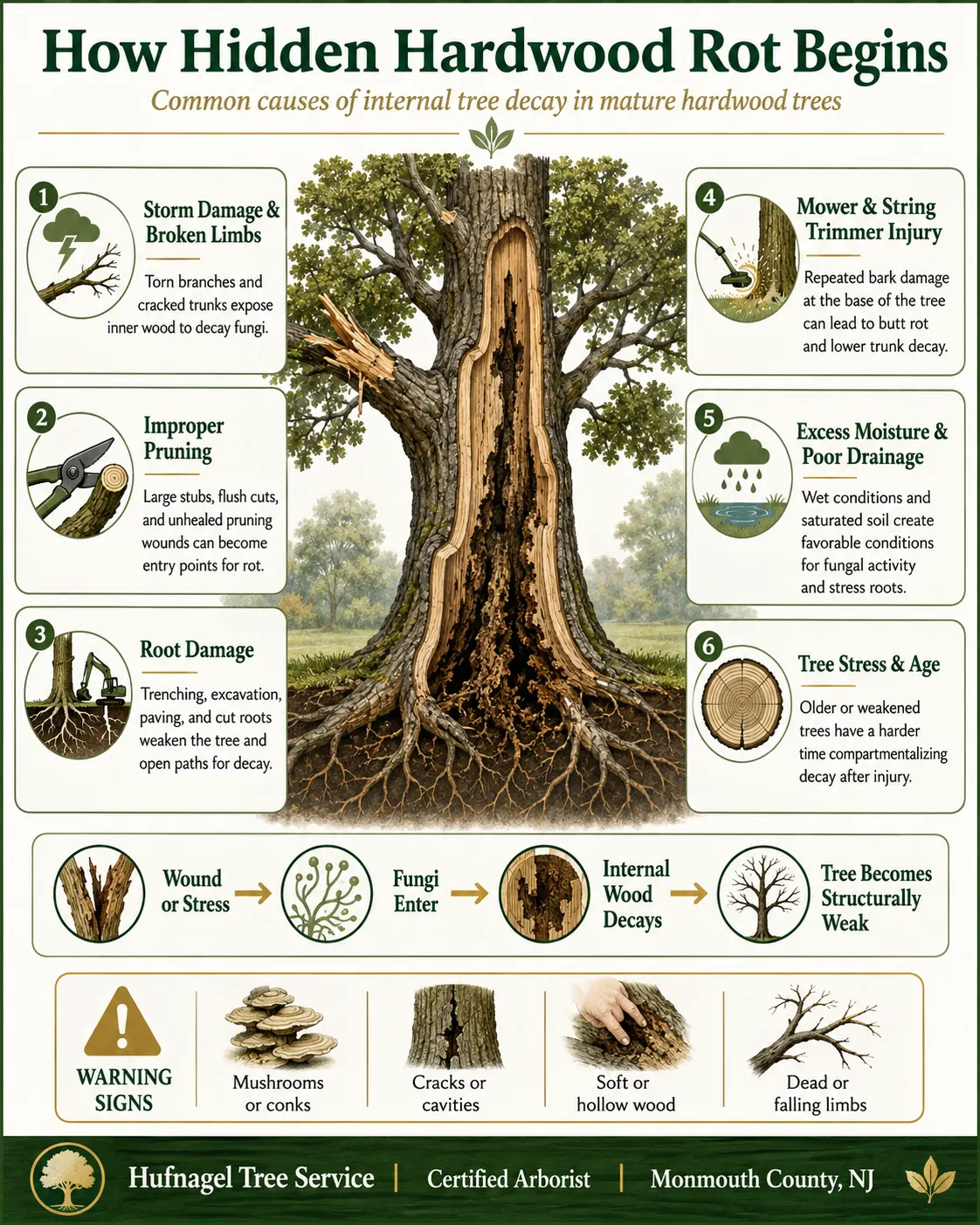
Tree rot usually starts when fungi enter through a wound. That wound may come from a broken limb, storm damage, poor pruning cut, mower injury, construction damage, root disturbance, bark crack, or old branch stub. UC IPM explains that most wood decay in limbs and trunks begins through exposed wood caused by injury, and those infections can decay heartwood, sapwood, roots, trunks, and limbs over time.
The hard part is that trees do not heal the way people heal. A tree can grow new wood around damaged tissue, but it cannot reverse old internal decay. Some trees compartmentalize decay well and remain stable for many years. Others lose strength quietly until the trunk splits, the base gives way, or a large limb breaks under its own weight.
That is why a certified arborist inspection matters. We look for the visible clues, but we also read the tree’s structure, species, site conditions, targets, history, and failure potential. When a rotted tree stands near a house, car, walkway, patio, business entrance, or play area, waiting can turn a manageable tree care decision into a property damage or safety emergency.
Hidden Tree Rot in Monmouth County NJ: What It Is and Why It Matters
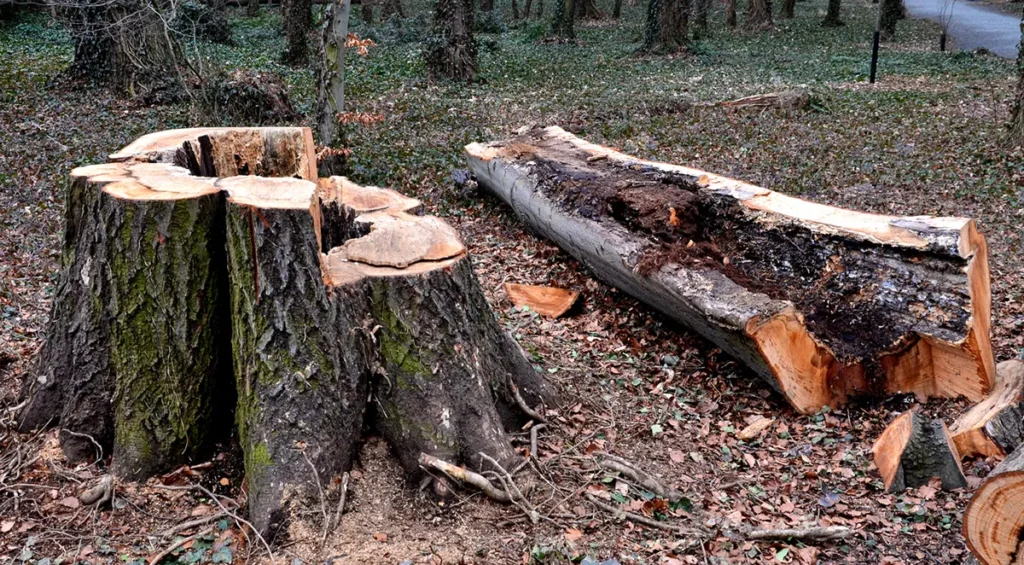
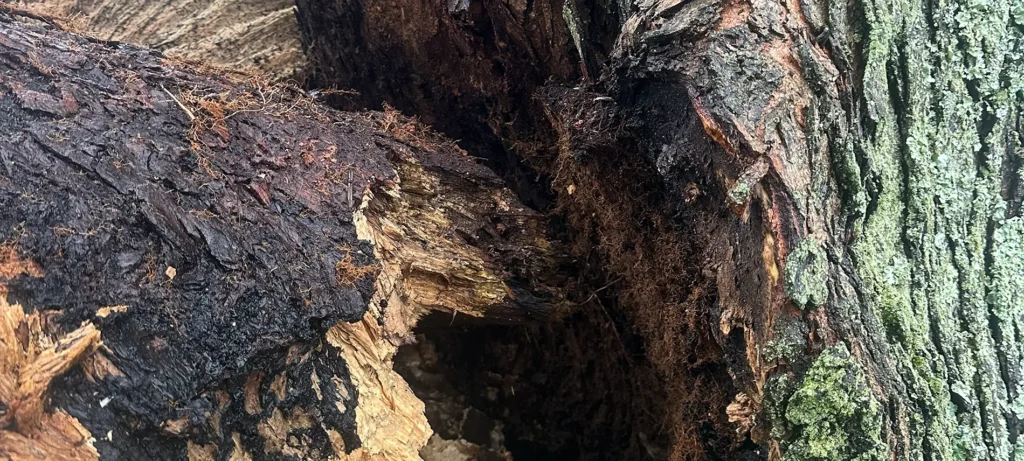
Hidden tree rot is internal decay that weakens the wood inside a living tree. In hardwoods, this often appears as heart rot, sap rot, butt rot, root rot, or decay around old wounds. The leaves may still be green. The canopy may still cast shade. The trunk may still look strong from one side. Inside, decay fungi may be breaking down the wood fibers that give the tree its strength.
The danger is not simply that the tree is “sick.” The danger is structural. Wood-decay fungi break down cellulose, hemicellulose, lignin, or a combination of those materials. Those are the components that help wood resist bending, compression, and splitting. UC IPM notes that decay fungi reduce wood strength and that decay can be hidden without outward signs. That is why a tree can fail even when the canopy still looks alive.
This issue matters in Monmouth County because many properties have older hardwoods that have been through decades of storms, pruning, construction, drought, flooding, soil compaction, and root disturbance. A mature oak near a driveway may have had roots cut during paving. A maple near a house may have old pruning wounds. A beech in a lawn may have mower damage at the root flare. These details matter because rot often starts where the tree was injured years earlier.
Our arborist observation is that homeowners often notice hidden rot only after something breaks. A limb tears out and exposes soft, dark, stringy, or hollow wood. A trunk cracks during wind. A mushroom appears at the base. A cavity opens where bark used to be. At that point, the question is no longer whether decay exists. The question is how much sound wood remains and whether the tree can still support itself.
Hidden rot does not automatically mean removal. Some trees have cavities and remain stable. Some can be managed with pruning, soil care, reduced stress, and monitoring. Others have decay in the wrong location, especially at the base, roots, or major branch unions. That is why we evaluate the tree before recommending tree restoration or tree removal.
Key points to understand about hidden tree rot:
- A tree can look alive while internal wood is already decaying.
- Rot often begins at old wounds, cracks, broken limbs, pruning cuts, root damage, or construction injury.
- Mushrooms, conks, cavities, cracks, and dead limbs can indicate internal decay.
- Hardwood rot can weaken trunks, branches, and roots until failure occurs.
- A certified arborist inspection helps determine whether the tree can be preserved or should be removed.
Hidden rot is a structural problem first. Once we understand where the decay is located, we can move from concern to a practical plan.
What Causes Hardwood Rot and Internal Tree Decay
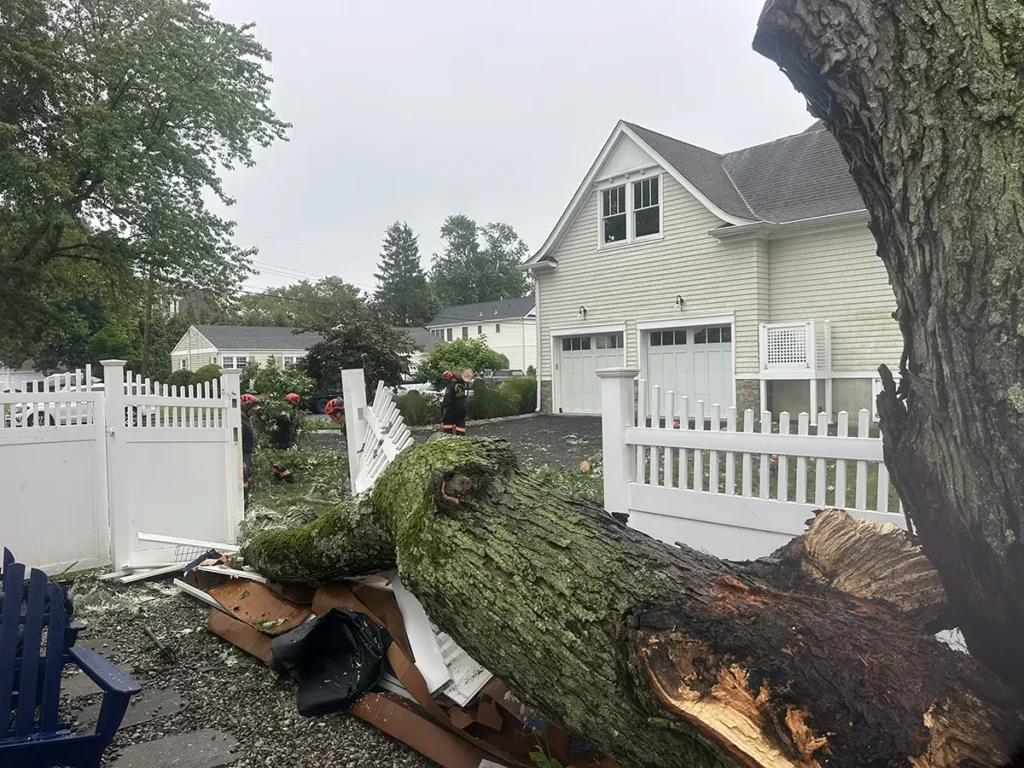
Hardwood rot usually begins when fungi gain access to exposed wood. A healthy bark layer protects the tree, but that protection can be broken by storms, branch failure, improper pruning, lawn equipment, excavation, utility work, vehicle impact, lightning, frost cracks, and animal damage. Once fungi enter, they can spread through dead or weakened wood inside the tree.
Moisture is a major factor. Decay fungi need the right conditions to grow, and damp wood or stressed tree tissue can help infection advance. Iowa State University Extension explains that cracks can become entry points for decay fungi and that moisture helps fungal bodies such as mushrooms and conks appear. In Monmouth County, wet seasons, drainage problems, compacted lawns, and storm-damaged limbs can all contribute to decay pressure.
Tree stress also matters. Trees weakened by drought, poor soil, grade changes, root cutting, insect pressure, repeated defoliation, or improper mulching may have fewer resources to defend themselves. UMass Extension notes that trees can often resist and compartmentalize Armillaria infections when healthy, but weakened trees are more likely to succumb to advanced decay and decline. The healthier the tree, the better its chance of slowing the spread of decay.
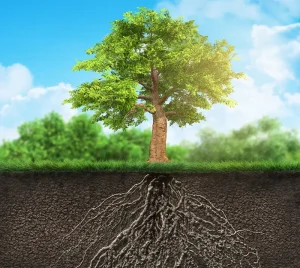
One common mistake we see is damage at the base of the trunk. String trimmers, mowers, mulch piled against bark, and soil covering the root flare can injure the exact area where stability matters most. Butt rot and root rot are especially concerning because they affect the lower trunk and anchoring roots. A tree with advanced decay near the base may fail from the ground line even if the upper canopy still looks full.
Our field tip is to treat wounds as history. A fresh wound tells us where decay may start. An old wound tells us where decay may already be active. Large pruning cuts, torn limbs, open cavities, seams in the bark, and old storm scars are not just cosmetic flaws. They are entry points and inspection points.
Hardwood rot often develops from these conditions:
- Broken limbs and storm wounds that expose inner wood.
- Poor pruning cuts, large stubs, or flush cuts that do not close properly.
- Mower and string trimmer damage at the root flare.
- Construction damage, soil compaction, trenching, and root cutting.
- Excess moisture, poor drainage, and long-term tree stress.
- Older age combined with repeated wounds and weakened defenses.
Once decay begins, the next question is whether the tree is successfully containing it or whether the rot is advancing into load-bearing wood.
How Internal Rot Causes Trees to Break Apart and Fail
Tree failure happens when the load on a trunk, limb, or root system becomes greater than the remaining sound wood can support. That load may come from wind, rain, snow, ice, heavy leaves, included bark, overextended limbs, or the tree’s own weight. Internal rot reduces the tree’s ability to carry that load.
A rotted limb may break because decay has hollowed out the branch where it attaches to the trunk. A rotted trunk may split because the outer shell is no longer thick enough to resist bending. A tree with root or butt rot may uproot or snap near the base because the anchoring system has been weakened. UC IPM explains that infected trunks and limbs can become unable to support their own weight and fall, especially when stressed by wind, heavy rain, or other conditions.
The failure can look sudden, but the process usually is not sudden. Decay may have been developing for years. The final break only happens when the remaining structure reaches its limit. That is why homeowners often say, “It looked fine yesterday.” The leaves may have looked fine. The internal support system did not.
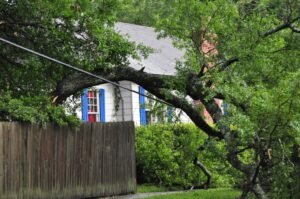
The most dangerous failures are the ones with targets below them. A large limb over a driveway can crush a vehicle. A decayed trunk near a home can damage a roof, siding, gutters, deck, porch, or fence. A tree near a sidewalk, business entrance, school route, or backyard sitting area can create a serious injury risk. The tree does not need to be completely dead to be dangerous.
Our arborist observation is that rot location matters more than rot appearance. A cavity high in a noncritical limb is different from decay at the base of a main trunk. A small conk near the root flare may be more serious than a large wound on a minor limb. A hollow sound in the lower trunk deserves more attention than a superficial bark scar.
Failure risk increases when rot affects:
- The root flare, buttress roots, or lower trunk.
- Large limbs over structures, driveways, patios, walkways, or parking areas.
- Branch unions with included bark, cracks, or old tear-outs.
- Co-dominant stems that already have weak attachment.
- Trees with both decay and a recent lean.
- Trees with canopy dieback, deadwood, mushrooms, cracks, and cavities appearing together.
Internal rot turns a tree from a living landscape feature into a structural question. That question should be answered before the tree answers it by failing.
Certified Arborist Tree Inspection for Hidden Rot
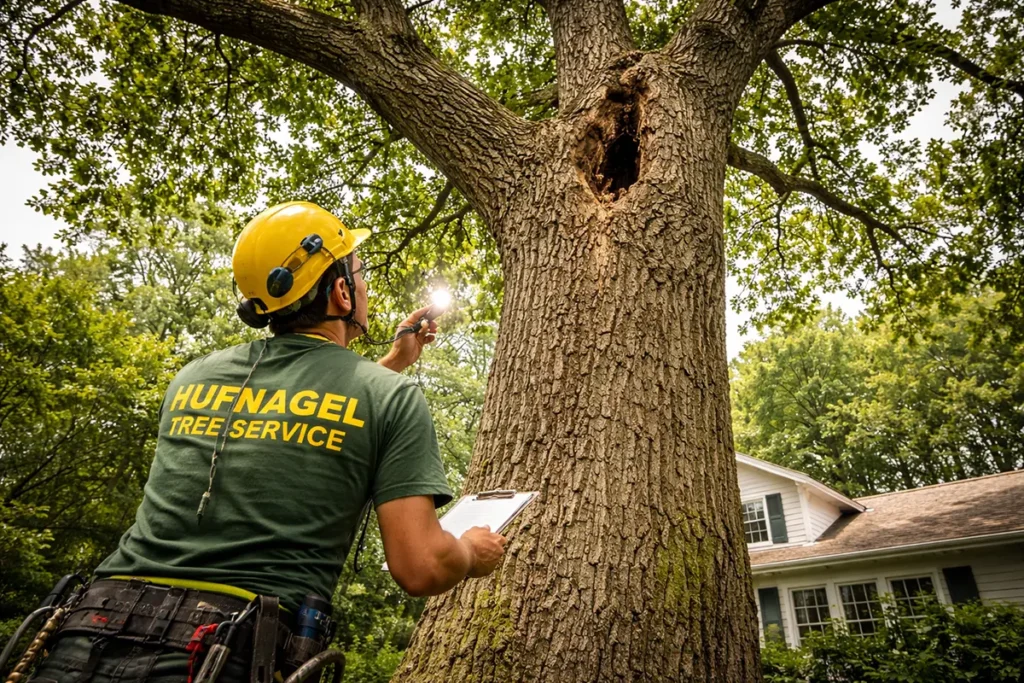
A certified arborist tree inspection starts with the whole tree, not just the obvious wound. We inspect the root flare, trunk, major limbs, branch unions, canopy density, deadwood, old pruning cuts, cavities, bark seams, fungal growth, soil conditions, and targets around the tree. The goal is to understand both tree health and tree structure.
Visual clues matter. Mushrooms at the base, shelf-like conks on the trunk, soft wood, hollow sounds, open cavities, peeling bark, large dead limbs, cracks, seams, sap flow, and sawdust-like material can all point toward deeper problems. Iowa State University Extension warns that trees with mushrooms or conks may pose a hazard if the tree fails and recommends evaluation by a trained arborist. Not every mushroom means immediate removal, but it does mean the tree should be looked at carefully.
We also consider the target zone. A decayed tree deep in the woods has a different risk profile than a decayed tree beside a house, driveway, pool, deck, sidewalk, business sign, or utility service. Forest Pathology’s hazard tree guidance explains that inspection depends on target distance, tree defects, judgment, and experience. In residential tree care, the target is often the reason action cannot wait.
Hufnagel offers tree risk evaluation services for homeowners who are concerned about hazards, structural issues, disease signs, and weak branches. Our inspection process is practical. We explain what we see, what it means, and what options make sense. Some trees need pruning. Some need restoration. Some need monitoring. Some need removal.
Our inspection tip is to call before the tree has obvious movement. A sudden lean, expanding crack, fresh soil lifting, or large limb failure can mean the tree has already crossed into emergency territory. Earlier inspection gives us more options and gives the homeowner time to make a safer decision.
A hidden rot inspection may include:
- Looking for mushrooms, conks, cavities, cracks, seams, and soft wood.
- Checking the root flare and lower trunk for butt rot or root decay clues.
- Evaluating major limbs, unions, old storm wounds, and old pruning cuts.
- Reviewing nearby targets such as homes, driveways, fences, patios, cars, and walkways.
- Recommending restoration, pruning, monitoring, or removal based on risk and tree condition.
An inspection does not commit you to removal. It gives you the facts needed to make the right call.
Tree Restoration When a Rotted Tree Can Still Be Saved
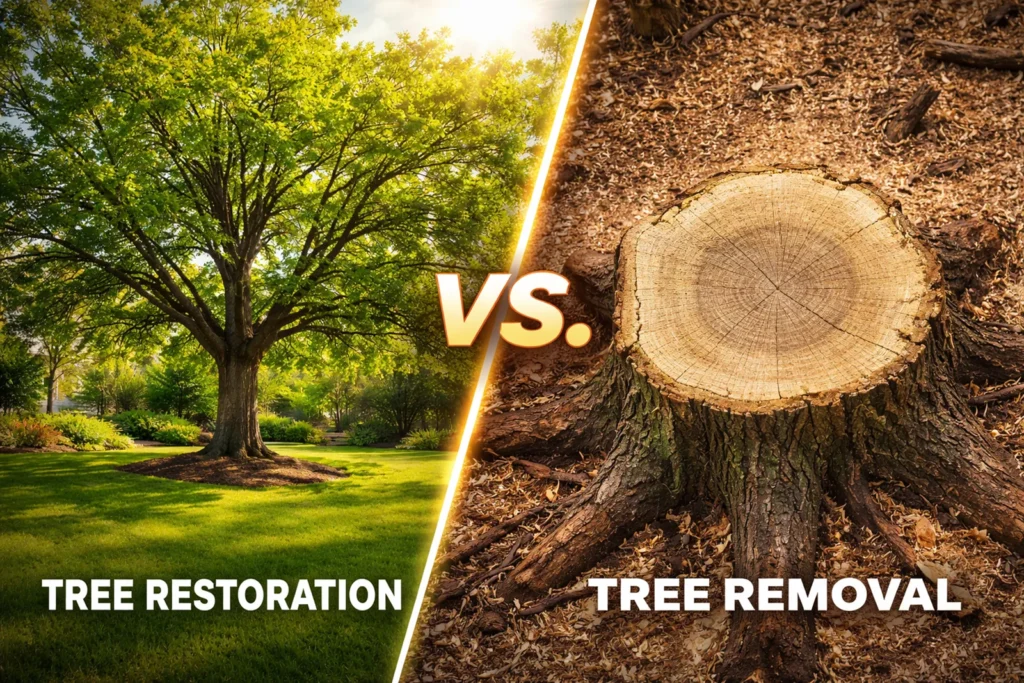
Tree restoration is possible when the tree still has enough structural integrity, vitality, and site support to recover or remain stable with care. The goal is to reduce stress, improve growing conditions, correct manageable defects, and preserve the tree where it is reasonable to do so. We do not remove a valuable tree just because it has a defect.
Hufnagel’s tree restoration and rejuvenation service focuses on evaluating tree condition, identifying stress factors, improving soil and nutrients, pruning properly, managing pests and disease, improving water practices, and using structural support when appropriate. That kind of approach is especially useful for trees that are declining but not yet structurally unsafe.
Restoration may include selective pruning to remove dead or diseased limbs, reducing weight on overextended branches, improving airflow, removing competing or rubbing limbs, correcting old poor cuts where possible, and reducing unnecessary stress on the canopy. If the root zone is compacted or buried, soil improvement, mulching, and root flare care may help the tree function better.
The local conditions matter. Monmouth County properties often have compacted lawns, old fill soil, patios, driveways, sidewalks, irrigation changes, drainage problems, and mature trees growing close to structures. A tree may be fighting more than decay. It may also be fighting poor soil oxygen, drought stress, root injury, or repeated storm loading.
Our arborist tip is to restore only when the tree gives us a reasonable foundation to work with. If the decay is limited, the canopy is still vigorous, targets are manageable, and the tree has enough sound wood, preservation may be a strong option. If decay is advanced at the base, roots, or main trunk, restoration may not be responsible.
Tree restoration may be appropriate when:
- Decay is present but the tree still has enough sound structure.
- The canopy is active, healthy enough, and not in severe decline.
- Defects can be reduced with pruning or structural support.
- Soil, moisture, mulch, or root-zone problems can be improved.
- The tree is valuable and does not present an unacceptable risk to people or property.
The best tree care decision is not always removal. It is the decision that matches the tree’s condition, location, and risk.
Tree Removal When Internal Decay Creates a Safety Risk
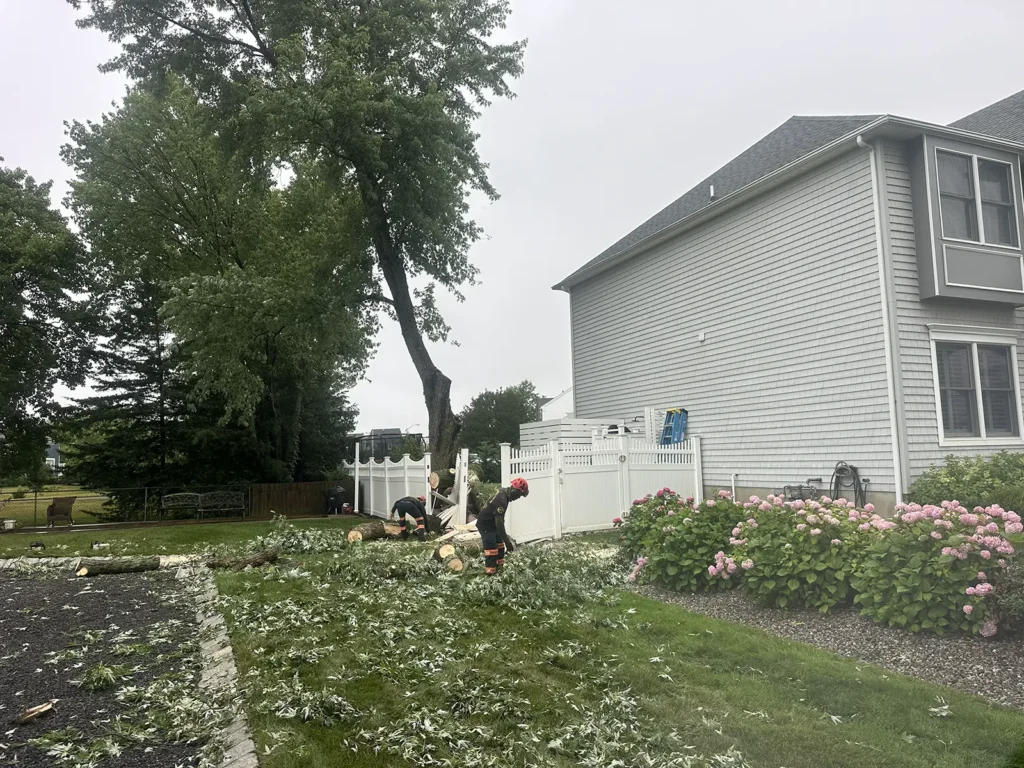
Tree removal becomes the right call when internal decay has compromised the tree beyond safe restoration. This can happen when the trunk is hollow with too little sound wood, the base has advanced butt rot, the roots are decayed, the tree has a serious lean, or large limbs are likely to fail over a target. At that point, the safest plan is controlled removal before uncontrolled failure.
Hufnagel’s tree removal service is built around professional assessment, safe removal planning, rigging, site protection, controlled cutting, cleanup, and property respect. That matters with rotted trees because decayed wood is unpredictable. A limb may not hinge normally. A trunk may split during cutting. A section may crumble, twist, or drop differently than sound wood.
Removal is especially important when the tree can hit a house, garage, pool, fence, shed, driveway, sidewalk, parked vehicle, service line, or neighboring property. Waiting does not make a severely rotted tree safer. It usually narrows the options. A planned removal is safer than an emergency removal after the tree has already damaged property.
Some homeowners hesitate because the canopy is still green. That is understandable. But a green canopy does not guarantee a sound trunk or root system. Internal decay is a strength problem, not just a leaf problem. A rotted hardwood can continue to leaf out while the lower trunk or limb attachment is structurally compromised.
Our safety advice is direct: do not wait for a dangerous tree to prove it is dangerous. If a tree has mushrooms at the base, a large cavity, a widening crack, a new lean, dead major limbs, or a hollow trunk near a target, have it inspected. Removal may not be required, but guessing is not a plan.
Removal may be necessary when:
- The lower trunk, root flare, or major roots show advanced decay.
- The tree has a new or increasing lean toward a target.
- Large limbs are hollow, cracked, dead, or poorly attached.
- The tree has severe canopy decline combined with structural defects.
- Restoration would not reduce the risk to an acceptable level.
- Failure could injure someone or damage a home, vehicle, fence, deck, or utility line.
When a rotted tree is beyond saving, safe removal is not giving up on tree care. It is protecting the people and property around it.
Call Hufnagel Tree Service for Certified Arborist Tree Rot Inspection in Monmouth County
If you suspect hidden tree rot, hardwood rot, internal decay, or a dangerous tree on your property, call Hufnagel Tree Service for a certified arborist inspection. We are based in the Middletown area and serve homeowners and businesses throughout Monmouth County with tree risk evaluation, tree health management, tree restoration, and safe tree removal.
With more than 25 years of local experience and 200+ five-star reviews, we help Monmouth County property owners make the right decision before a weakened tree breaks apart. Call Hufnagel Tree Service to schedule a tree rot inspection and get clear answers from a certified arborist.
Schedule Service Now!
From precision pruning and safe removals to health assessments and preventative care, Hufnagel Tree Service delivers expert solutions backed by decades of experience. We offer certified insight, fair pricing, and a commitment to doing what’s best for your landscape.
Learn More About Our Services
Related Articles
Matawan Fall Tree Care: Prepare Trees Before Winter
Tree Risk Inspections in Sea Girt, Spring Lake & Little Silver
Storm Damaged Trees in Aberdeen: We Can Help